ROI is a core business metric often searched by business owners, students, and professionals wanting to understand investments. Knowing the ROI full form and its simple meaning helps people make informed financial decisions. business
This article will clearly explain what ROI stands for, its practical meaning, Hindi explanation, key facts, and answer common questions about this term.
What Is the Full Form of ROI?
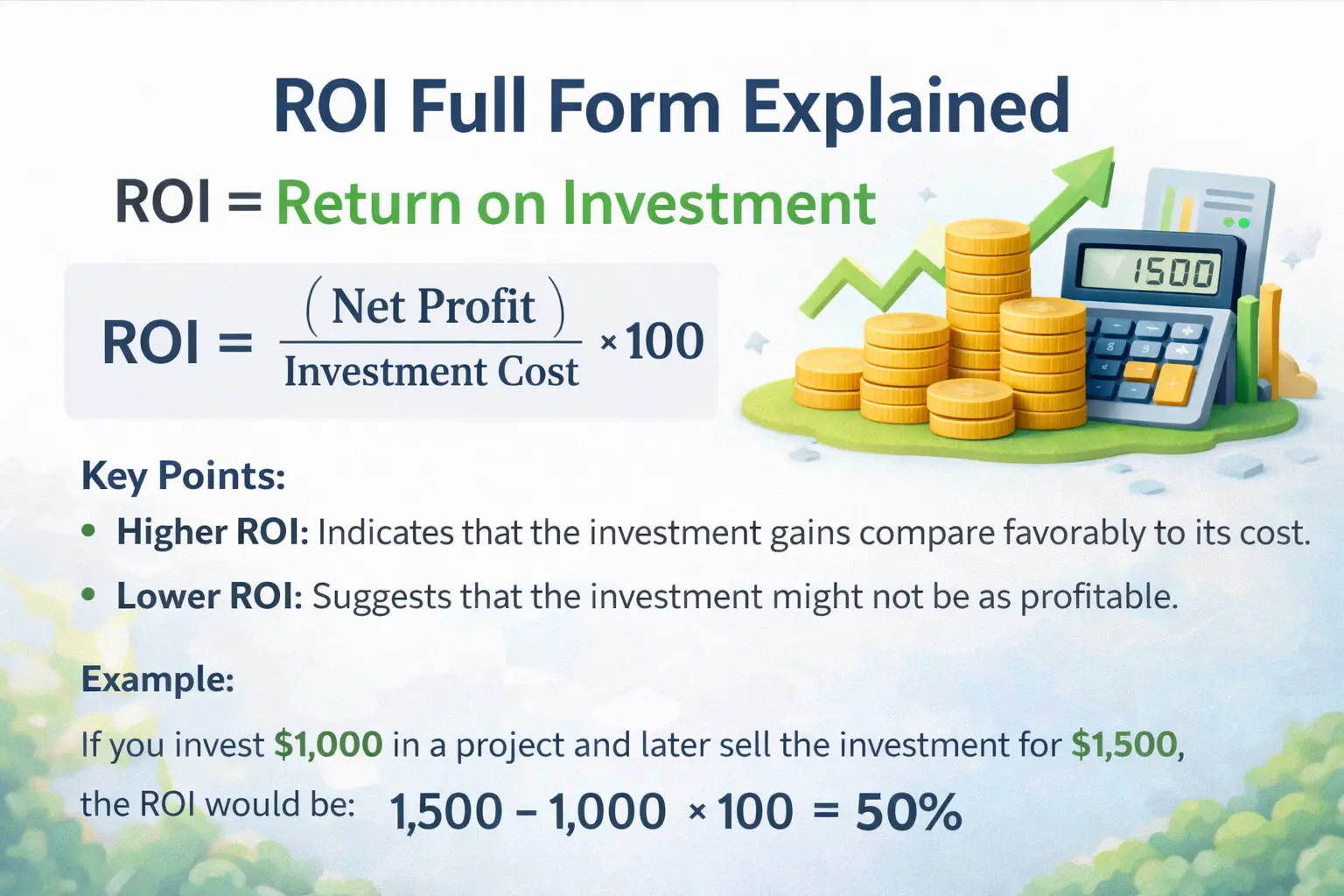
The full form of ROI is Return on Investment.
- Return on Investment (Business/Finance): Measures how much profit or loss is generated compared to the amount invested.
Simple Meaning
ROI means finding out how much you earn, or lose, on an investment relative to the money you put in. For example, if you invest $1,000 in a project and later get back $1,200, your ROI is the profit ($200) divided by the investment ($1,000), which gives you 20%. It’s a quick way to check if your investment was worth it or not.
Hindi Explanation
ROI का मतलब है "Return on Investment" – यानी आपने कितना पैसा लगाया और बदले में कितना फायदा (या नुकसान) हुआ।
- यह बिज़नेस या निवेशों में performance मापने का तरीका है।
- उदाहरण: अगर आपने 10,000 रुपए लगाए और 12,000 वापस मिले, तो ROI = 20%।
- ROI से आप जल्दी समझ सकते हैं कि निवेश सही था या नहीं।
Hinglish में: ROI matlab, apne jitna paisa lagaya, us par kitna munafa (ya nuksan) hua.
Quick Meaning
- ROI = (Net Gain from Investment ÷ Amount Invested) × 100%
- Shows how profitable an investment is.
- A higher ROI means a better return.
- Used in business, marketing, real estate, and stocks.
- Helps compare which projects or options are better.
- Negative ROI means a loss on investment.
- Very useful for budgeting and strategy.
- Expressed as a percentage.
- Widely used by companies and investors alike.
Examples
- A marketing campaign costs $500 and generates $1,000 in new sales. ROI = 100% profit.
- Investing ₹50,000 in a shop, and earning ₹55,000 back: ROI = 10%.
- Buying stocks for $2,000 and selling at $1,800: ROI = -10% (a loss).
- Comparing different savings accounts by ROI helps pick the best one.
Common Confusion
- ROI shows past performance, not guaranteed future results.
- It's not the same as profit; ROI is the percentage based on what was invested.
- ROI does not consider time – earning 10% over 1 year vs. 10 years is different, but ROI alone won't tell you that.
- Return on Investment is not limited to money; businesses use ROI to measure results of effort, time, or resources too.
Where Used
- Business project assessments.
- Marketing campaigns and ad spending decisions.
- Stock market investments.
- Real estate purchases.
- Personal finance planning.
- Startup and venture capital evaluations.
FAQs
What is the ROI full form explained in simple words?
ROI stands for "Return on Investment", showing how much profit you earned compared to the amount you invested, usually as a percentage.
Is ROI the same as profit?
No, ROI is the ratio or percentage of profit relative to your original investment, while profit is just the extra money earned.
Can ROI be negative?
Yes, if your investment loses money, the ROI will be negative, indicating a loss.
How do I calculate ROI?
Subtract the initial investment amount from the final amount, then divide that gain or loss by the initial investment, and multiply by 100 for percentage.
Is ROI only used in finance?
No, ROI is also used in marketing, real estate, operations, and even personal projects to compare results versus effort or cost.
What’s the difference between ROI and ROE?
ROI means Return on Investment, measuring returns on any investment. ROE stands for Return on Equity, focusing only on a company’s equity returns.
Does ROI consider investment time?
Standard ROI does not include time, but other metrics like annualized ROI or IRR do.
Conclusion
ROI, or Return on Investment, is a simple yet powerful way to measure how much benefit you’ve gained from an investment. Whether in business or personal finances, understanding ROI helps you make smarter decisions with your money and resources.
