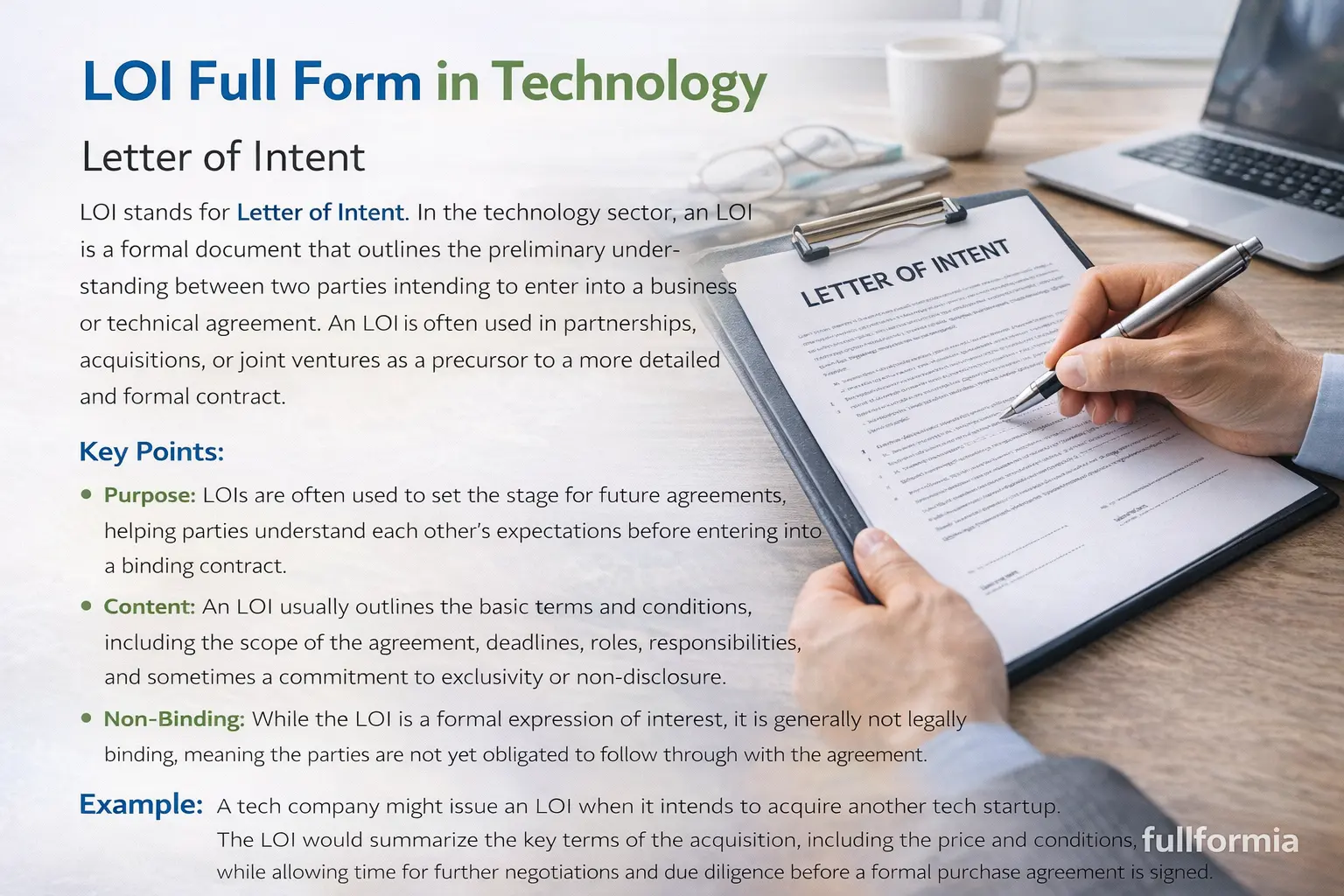
LOI is a common acronym in business and technology, frequently searched by beginners and professionals alike who encounter it in documents and deals. Understanding its meaning is important for anyone reading contracts, proposals, or tech project paperwork. business
- Get the clear full form and meaning of LOI in technology.
- See simple explanations and examples for beginners.
- Learn typical uses, common confusions, and key points in business context.
LOI Stands For What?
The full form of LOI is Letter of Intent.
In technology and business, it's often used during the early stages of partnerships, projects, or deals.
- Letter of Intent (Business/Technology): A formal document showing interest in a business deal before signing a final contract.
- Loss of Information (Technical/Data): Sometimes used to describe data loss, but less common in the business context.
Easy Meaning in Plain Words
In simple words, a Letter of Intent (LOI) is a document that says one party is interested in working with another. It shows serious intentions to move forward, but it is not yet a final agreement. For example, a software company might send an LOI to a potential client to outline major terms before they sign a formal contract.
Hindi Meaning and Use
LOI का मतलब है "लेटर ऑफ इंटेंट" – यानी एक ऐसा दस्तावेज़ जो किसी सौदे में दिलचस्पी और इरादा दिखाता है।
- LOI से पता चलता है कि पार्टियाँ बातचीत के लिए गंभीर हैं।
- अंतिम Contract बनने से पहले ये डॉक्युमेंट बनता है।
- Hinglish: "Client ko LOI bhejna hai project shuru karne se pehle."
Simple Breakdown
- LOI means “Letter of Intent.”
- Used in business, technology partnerships, and project discussions.
- Outlines key points, intentions, or terms between parties.
- Shows interest but is not usually legally binding.
- Often comes before a full contract.
- Helps set expectations and start negotiations.
- May cover pricing, timelines, or project goals.
- Can be used for company acquisitions, software deals, or tech collaborations.
Examples
- A mobile app developer sends an LOI to a startup, stating their plan to build a new product together.
- Before buying new CRM software, a retailer and the vendor sign an LOI outlining expected features and delivery time.
- Two tech companies exchange LOIs to explore a possible merger, discussing broad terms ahead of legal paperwork.
Common Confusion
- LOI does not mean a final contract; it’s a starting point showing interest.
- Some think LOI is legally binding, but it usually is not (except for specific clauses).
- Not to be confused with an “Offer Letter,” which usually confirms a job offer.
- Sometimes people mix up LOI with “Loss of Information” in data or tech contexts, but that’s far less common in business use.
Where Used
- Tech partnerships and software development deals.
- Business acquisitions and mergers.
- Supplier and vendor negotiations.
- Joint ventures in IT projects.
- Large technology purchases or outsourcing agreements.
FAQs
Is an LOI legally binding?
Usually, a Letter of Intent is not legally binding, except for some specific sections like confidentiality or exclusivity. It’s mostly a roadmap for future agreements.
What is included in a typical LOI?
An LOI often lists the main terms, timelines, pricing ideas, and the intentions of parties. It clarifies what both sides want before writing a full contract.
What is the LOI full form in technology?
In technology, LOI most often stands for Letter of Intent, a document showing intention to collaborate, buy, or form a business deal.
How is LOI different from a Memorandum of Understanding (MoU)?
Both show intent, but an MoU is usually more detailed, sometimes more formal, while LOI is more about signaling initial interest and key points.
Can LOI be used in fields other than technology?
Yes, LOI is common in real estate, education, banking, and other industries whenever parties want to signal their intent before a binding contract.
Is an LOI required for every technology partnership?
No, but it helps avoid misunderstandings and keeps discussions clear, especially in larger or complex projects.
Are there other meanings of LOI besides “Letter of Intent”?
Occasionally, LOI can mean “Loss of Information” in technical data contexts, but “Letter of Intent” is the main meaning in business and technology.
Summary
LOI means “Letter of Intent”—a document showing serious interest in a deal before a final contract is signed, especially in business and technology. It sets the stage for negotiations but is usually not legally binding.
