If you’re planning to study or work abroad, you may have seen the term “IELTS” pop up everywhere. But what exactly does IELTS stand for, and why is it so important for students and professionals alike?
This article explains the IELTS full form, its meaning, and key facts—all in beginner-friendly language. Whether you’re confused about what IELTS means or just want a quick overview, you’ll find straight answers here.
What Is the Full Form of IELTS full form definition?
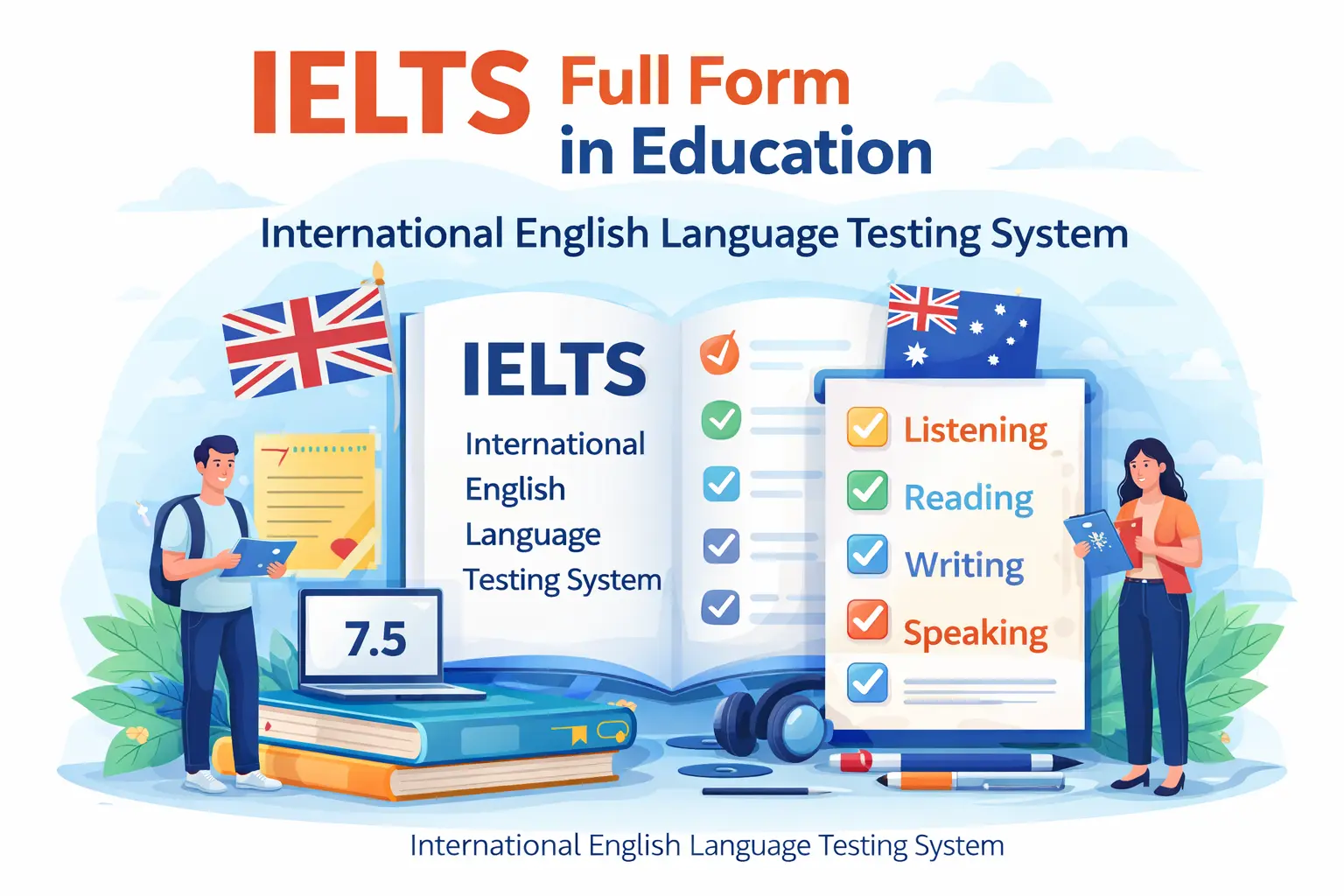
IELTS stands for International English Language Testing System. It’s a widely recognized test that measures English language proficiency for non-native speakers.
Meaning and Simple Explanation
Simply put, IELTS is an exam that checks how well someone can use English, especially if they want to study, work, or migrate to an English-speaking country. For example, if Priya wants to take a masters course in Canada, she may need a good IELTS score to prove she understands English well enough for her studies.
Quick Overview
- Full Form: International English Language Testing System
- Category: Education
- Purpose: Tests English language skills
- Who Takes It: Non-native English speakers
- Accepted In: Over 140 countries
- Main Uses: Study, work, or migration abroad
- Exam Types: Academic and General Training
- Skills Tested: Listening, Reading, Writing, Speaking
- Popular Regions: UK, Australia, Canada, New Zealand, USA
Why People Search This Term
- To understand what IELTS means before applying for exams
- Students planning to study overseas
- Professionals aiming to work abroad
- People migrating to English-speaking countries
- For accurate information during college admissions or visa processes
Key Details
Types of IELTS Exams
There are two main IELTS exams—Academic (for higher education) and General Training (for work or migration).
Exam Format
IELTS tests four language skills: listening, reading, writing, and speaking. Some parts are written; the speaking part is a face-to-face interview.
Scoring System
Scores are given as “bands” from 1 (non-user) to 9 (expert user). Most universities require a band between 6 and 7.5.
Global Recognition
IELTS is accepted by thousands of institutions and immigration agencies worldwide, making it a trusted measure of English ability.
Common Mistakes
- Confusing IELTS with other English tests (like TOEFL)
- Not knowing the difference between Academic and General IELTS
- Assuming only students need IELTS
- Believing IELTS scores last forever (they’re valid for 2 years)
- Thinking you can take it without preparation
- Misunderstanding band scores and requirements
- Leaving speaking practice until the last minute
FAQs
What is the full form of IELTS?
IELTS stands for International English Language Testing System.
Who needs to take IELTS?
Anyone planning to study, work, or migrate to countries where English is the main language may need IELTS.
How is IELTS different from TOEFL?
Both are English tests, but IELTS is often preferred in the UK, Australia, and Canada, and its format differs from TOEFL.
How long is an IELTS score valid?
Most institutions accept IELTS certificates that are less than two years old.
Can I take IELTS online?
Some centers offer computer-based IELTS, but the speaking part is always done with an examiner, either in person or online.
Which exam should I take: Academic or General Training?
If you’re applying for higher education, choose Academic. For work visas or migration, General Training is usually required.
Is IELTS difficult?
The difficulty depends on your English ability and preparation, but it’s designed for all English learners.
Final Words
IELTS stands for International English Language Testing System—an essential test for anyone hoping to prove their English skills for study, work, or migration. Knowing its meaning and requirements is a key step if you dream of opportunities abroad.
