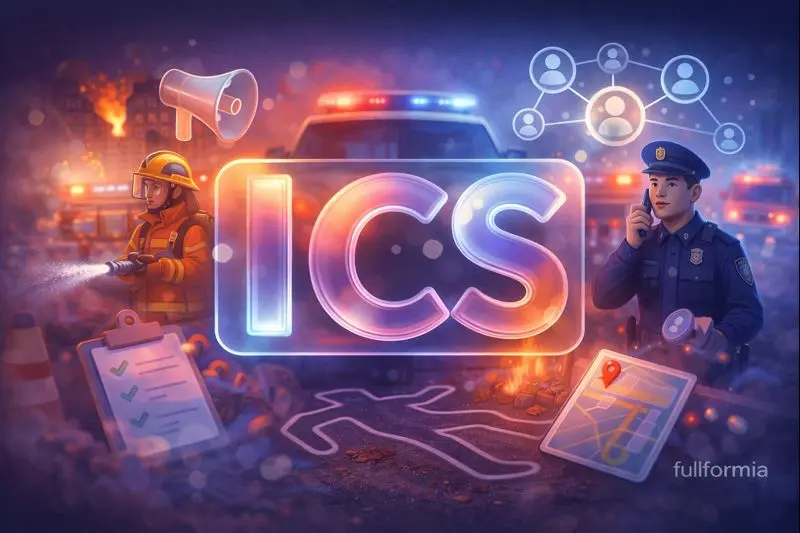
If you’ve ever heard about emergency management or disaster response, you might have come across the term “ICS.” Many people wonder what this term actually stands for and why it’s so important. In this article, you’ll discover the full form of ICS, what it means, and essential facts that make it a cornerstone for organizers and responders worldwide.
Whether you’re a student, a beginner in emergency management, or just curious, keep reading for a quick and clear breakdown of ICS. You’ll learn the basics, see real examples, and clear up some common confusions about this popular term.
What Is the Full Form of ics full form?
The full form of ICS is Incident Command System.
The Incident Command System (ICS) is an organized approach for managing emergency incidents of any size or type.
Meaning and Simple Explanation
The Incident Command System (ICS) is a standardized method used by various organizations—like fire departments, police, medical teams, and government agencies—to manage emergencies, disasters, or big events efficiently. Medical responders such as EMT teams often work within the ICS structure during incidents.
Real-life example: If there’s a large wildfire, different teams (firefighters, police, medical aid) use ICS to coordinate efforts, assign roles, and share information. This clear structure avoids confusion and helps save lives.
Quick Overview
- Full Form: Incident Command System
- Category: Emergency Management / Organizational Systems
- Main Users: Fire departments, EMS, police, disaster response teams, event coordinators
- Purpose: To organize and manage emergency responses
- Where Used: United States and worldwide
- Key Features: Standardized structure, clear roles, scalable design
- Origin: Developed in the 1970s
- Also used for: Planned events and public gatherings
- Common Context: Disasters, emergencies, large-scale operations
Why People Search This Term
- To know the meaning of “ICS” in safety or emergency contexts
- For exam preparation or interviews
- To understand disaster and emergency response plans
- Curiosity from news reports or documentaries
- To ensure correct usage in academic or professional writing
Key Details
Core Elements of ICS
ICS divides responsibilities into standard roles such as Incident Commander, Operations, Planning, Logistics, and Finance. This structure helps responders like HOD-level officials and field teams work together smoothly.
Benefits
ICS reduces confusion, improves communication, and speeds up decision-making during emergencies or large events.
Scalability
Whether it’s a small road accident or a nationwide disaster, ICS can scale up or down based on the situation. In large public events, it may even integrate with broader organizational roles similar to COO-style coordination.
Common Mistakes
- Thinking ICS is only for firefighters
- Assuming it’s only for large-scale disasters
- Confusing ICS with IT or software-related terms
- Using “ICS” for the wrong abbreviation
- Overcomplicating the structure unnecessarily
- Believing training isn’t needed for small incidents
- Ignoring its usefulness for non-emergency events
FAQs
What is the full form of ICS?
ICS stands for Incident Command System.
Who uses the Incident Command System?
Emergency responders such as firefighters, police, medical teams, and event managers use ICS.
Where did ICS originate?
ICS originated in the United States during the 1970s to manage large wildfire incidents.
Is ICS used worldwide?
Yes, many countries have adopted ICS or similar systems for emergency management.
Can ICS be used for non-emergency events?
Yes, it is often used for concerts, sports events, festivals, and other large gatherings.
Is special training needed for ICS?
Basic training is recommended to understand and apply ICS effectively.
Final Words
The Incident Command System (ICS) provides a reliable and flexible way to manage emergencies and complex operations. Knowing its full form and purpose helps students, professionals, and the general public better understand how coordinated response systems work.
